The best recommendation seems to be an attached cedilla for Marshallese. This article at ScriptSource is very helpful.
https://scriptsource.org/cms/scripts/page.php?item_id=entry_detail&uid=jqlp8bzm8m
3 Likes
Thank you for the article @George_Thomas it will be of great help! I’m still confused by the seemingly incomplete solution in Glyphs3 for Marshallese (which admittedly I know nothing about). As @NolanPaparelli pointed out, Mcedilla, Ocedilla, mcedilla and ocedilla are not included in the Oceanian Language preset. Since I know how @GeorgSeifert and @mekkablue have a detailed approach to solving these kind of problems and always offer a complete solution, I have to ask — is there something I’m obviously missing here? 
As mentioned above, these are composed with the mark feature and anchor directly at the application level instead of at the font level. You can include them at the font level if you prefer with names like m_cedillacomb, etc.
Note: Glyphs seems to generate commaaccentcomb.loclMAH as a composite of commaccentcomb instead of cedillacomb, and adds unnecessary languagesystem DFLT MAH and lookup locl_noScript0.
1 Like
@GeorgSeifert @mekkablue the problem is not that comma below should look like a cedilla in Marshallese but rather that the cedilla should look like the cedilla. Substituting the comma below in Marshallese with lookup locl_noScript0 doesn’t make sense. Marshallese uses characters with cedilla.
@GeorgSeifert @mekkablue
Hello, in version 3228 the auto code for Marshallese is generated wrongly, perhaps in connection with a new feature, Add support for four letter lang tags. My screenhots:
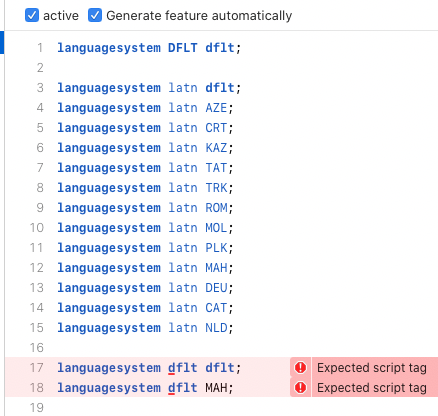
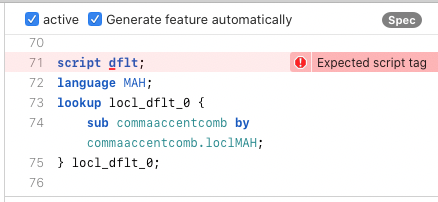
I fixed that yesterday.
1 Like
Has anyone ever had their fonts used by Marshallese designers?
@NolanPaparelli The Marshallese translation of JW.org material is using fonts with glyphs designed for Marshallese.
As you pointed, the locl feature isn’t easily accessible in some applications, and variants probably should be in a stylistic set to be more accessible. This is true in general for any cedilla character which may be displayed with either form depending on context and practice.
For years we have used a Marshallese keylayout that works well. We add it (on a Mac) to the keyboard inputs in System Preferences. Then we can choose the US English or the Marshallese keyboards. I leave the Marshallese one on all the time since it works fine for English too. The keystrokes are quite easy: for the marks under letters: hold option and hit the comma key, let both go, and hit the desired key (ḷ, ṃ, ṇ, or ọ). For the tilde over the letters, hold the option and hit the - key, let both go, and hit the desired letter (ō,ñ,ū or ā). How the diacritical appears (whether a true tilde or something else) will depend on the font used.
2 Likes
Yokwe! That’s great to see the characters of the Marshallese-English Online Dictionary are used instead of the ones used in the earlier printed version. Are there still a lot of Marshallese texts using the cedilla or comma below instead of the dot below?
It is very rare that any Marshallese use any of the markings under letters. At least, that is true of those who write to me. I used to do a lot of medical and court translation docs, but I have given that work to a co-worker. We have always used the MED since around 1990. When we have been asked to edit docs which certain Marshallese have translated, we note that they don’t follow the MED orthography. For many years, there was no standard, so people are used to doing whatever they want in regards to spelling and orthography. The young people in schools now are taught to use the MED spelling. As far as the nature of the mark under letters, we consulted with Dr. Byron Bender about it, and he said that it really did not matter much which mark was there as long as there was a mark under the 4 key letters. He had created fonts, and we did the same, but now we use whatever Unicode fonts have letters with diacriticals.
1 Like