I recall this was possible in the early days of Glyphs 2 but I think Georg said it wasn’t intended behaviour
The use case for this is for example in tabular glyphs where in lighter masters it’s possible to use components of the proportional glyphs, but in the heavier masters, narrower versions must be drawn. The other masters have to be decomposed but it gets messy to sync and propagate any changes manually. It would be great to allow components to interpolate with paths.
Perhaps some kind of “decompose this component on export” setting on the component?
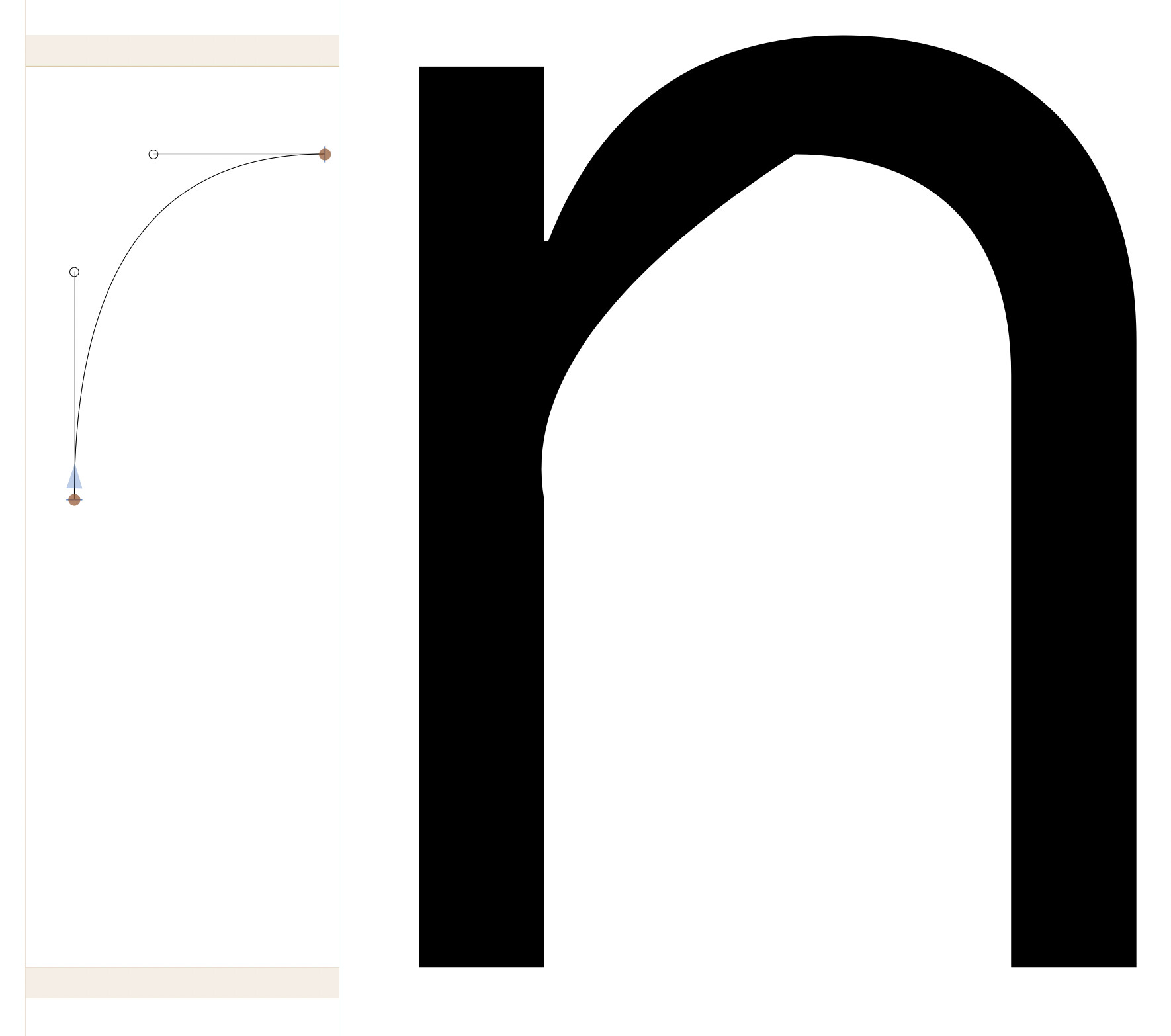
It would be a game changer to have more robust path components for that purpose. Basically, imagine you could paste n as a bunch of independent segment components (linked to their respective segments in the n glyph itself), then extend a couple of its segments and get h without ever decomposing it.
With the same mechanism, you can make tabular figures by transforming the proportional ones, without decomposing them. And since it’s all just a path made of segment components, you can also take your proportional 1 and add serif components to its nodes for the tabular 1.
Moreover, segment components are independent, so you can remove some of them and stitch the path with something else. Make ae out of partial components of a and e, perhaps connected with plain paths.
I’ve tried that as a plugin with some success, but not competent enough to make it reliable (the undo manager is tricky, keeping it in sync and such…).
I suppose, an option to deactivate angle fitting might be useful, but not sure without being able to try.
It would also be useful to use any segment as a component without extracting it into a separate glyph. Since angle fitting is not needed, it should probably be ok without anchors.
Then you can just paste n’s path as a list of segment components into h, and modify it from there. All without decomposing or decomposing only some segments (which would be the case for more different target glyphs, such as /ae).
I can’t see a use case for this for myself and I’m not sure it would solve the problem I’m describing above that. Any thoughts on the component idea? @GeorgSeifert