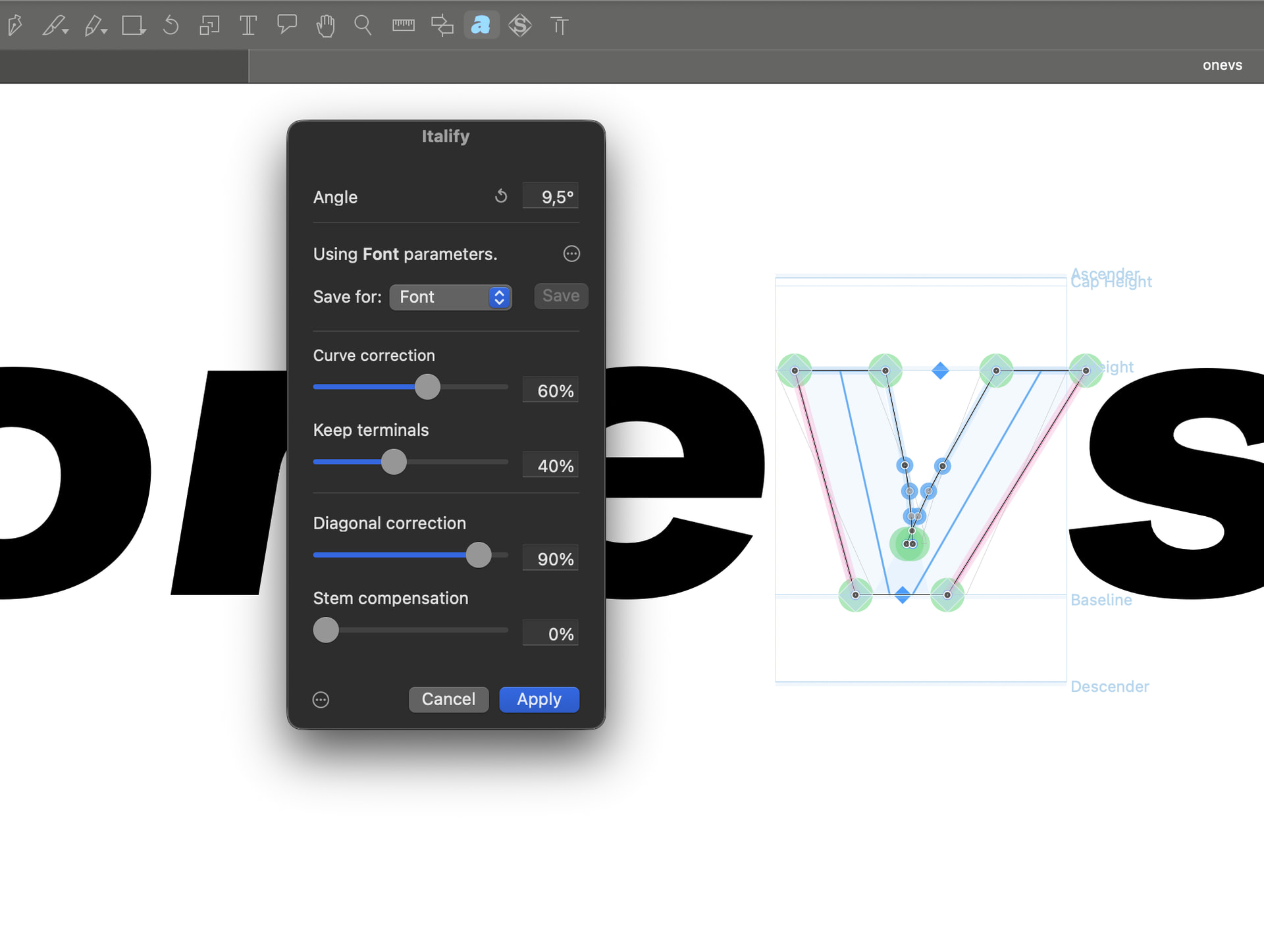
The plugin allows you to generate optically corrected obliques in a fraction of the time you’d usually spend, at very high quality. From my experience with many clients who used the service, it can get you up to 95% of the way to the final oblique, depending on the design and your taste.
Italify can currently be licensed per week (unlimited masters) or per master (unlimited time). Contact me for custom licences (monthly, yearly…). The current pricing is deliberately aimed at foundries working on custom jobs, as a way to trial the plugin and workflow, collect feedback and improve the algorithm.
A handbook, a fully functional free trial (48h), licensing information and a Python API documentation are all available on the website.
I’m happy to give demos and introductions in person (Paris/Berlin/London) or by video, just contact me.
This plugin looks fantastic. Congratulations on the launch and on building something that seems genuinely useful. Unfortunately, the pricing is a bit too steep for most independent type designers, so it’s hard to justify. It’s also one of those features that feels like it would have been a natural addition to Glyphs itself. I’d love to use it if it were more accessible.
Yes, I’m well aware. Sorry about that. I’m very actively trying to figure out more sensible pricing that is fair for everyone. For the time being, this is priced for foundries working on custom fonts, under time pressure. For now, I want to keep the user circle small, so that I can collect and react to feedback sensibly. The pricing works well for a small number of foundries at the moment, so I’m achieving that goal.
What I would be interested in: what do you think is a fair price for a time-based licence and a per-master licence? This is a model I want to keep, but I would be very keen on adjusting the current price tags. Any feedback here is welcome!
First of all, I really appreciate your openness. I completely understand that you’re trying to make a living from your work. I run a type foundry myself, so pricing is something we constantly struggle with as well. There’s never a perfect answer.
Personally, I don’t think the issue is whether you charge per master or by time. I think either model can work, as long as the price feels aligned with the rest of the ecosystem.
For context, Glyphs itself is around €300 as a one-time purchase, and many of the essential tools we all rely on are in the same ballpark or significantly less, like RMX Tools at US$99. I think the general feeling within the type community has always been that we try to support each other by keeping professional tools reasonably accessible.
The plugin clearly provides a lot of value, especially for foundries working under deadlines, and I don’t think anyone expects it to be free. My feeling is simply that the current pricing sets a very high threshold for adoption, particularly for smaller foundries and independent designers who would also benefit from it.
I’m glad you’re treating the current pricing as something to iterate on. I think you’ll find many more people eager to buy and recommend it if the pricing feels more in line with what the community has come to expect from Glyphs-related tools.
My issue currently is that I don’t know how to price it correctly. Would anybody be willing to suggest a price per master or per time period (in tiers as outlined on the website) that feels reasonable for them, maybe with some extra context (foundry size, etc.)? Also by DM, happily, if preferred.
Hey! I have been waiting for this tool so I was excited to hear it’s out. I just tried it, and I must say it’s for sure THE BEST effort so far in creating a tool to help with Italics.
Impressing work, it’s almost there!!!
But… it’s not 100% perfect yet, and with a pricing like you got, I think it has to be like you press a button, and things just look great out of the box – then I would pay quite much for it, since that would save me time.
In it’s current state, it will take more time (or at least similar amount ) to use this plugin and doing manual after-corrections compared to just using my normal semi-manual workflow for Italics. The upside of doing it manually is that you have 100% control and don’t need to go back and fix things since you trust yourself more than a plugin.
Glyphs 4 “Slanter” is good, but not doing things as good as your Italify, but that is free on the other hand, and we do have a lot of acceptable but not perfect Italics out there from quite respectable foundries (ehum…). So maybe that’s good enough for many if they don’t want to work on a human made Italic (?). Will the majority of type designers/designers/font users even see a big difference between the two? Not so sure about that, to be honest.
As Andrei previously wrote, I also think a good comparison is with RMX regarding the price. A lovely tool that so many people use. It’s very similar in the way it helps out with the “boring stuff”. If you want a lot people to use this tool I would definately think twice about the pricing. RMX is a however too cheap, I think. What it does is worth so much more.
Cheap or Expensive; I would prefer a one-time fee for this plugin in any case. And I really hope you nail all the details some day, so I can buy it and just relax and press the button
Thanks for the enthusiastic feedback! Much appreciated.
Would you mind sending me some examples of what doesn’t work as expected? I’m very actively working on it, and trying to iron out all the little bugs. Your feedback would be very helpful.
I agree, RMX is far too cheap, or at least it was – nowadays, the 10-master limit is definitely a deal breaker. But I digress.
A quick word on the Slanter: I’m sure you’ll see a stark difference when applying Italify (especially on designs with inktraps, diagonal correction… Everything, actually).
I’m sorry to say that I really don’t think I will be offering a one-time purchase anytime soon. I do, however, want to price it reasonably per master. I think of it as a tool similar to iKern, even though it delivers results that still should be tweaked manually (and that’s good). I received a lot of requests to exit the service model, where I was simply applying the filter to everything myself. I still want to keep the pricing project-bound, though, it’s just a question of finding a good middle ground.
Again, if someone has some concrete numbers to throw at me, this is your chance to shape Italify’s pricing in your favour
Just to throw in my two cents on pricing, I’d personally be happy to pay a monthly per-seat subscription of up to €100. I think that would feel much more in line with what more people could justify.
Also, while I understand the focus on custom font projects, there are far more small foundries and independent type designers than there are foundries primarily doing custom work. Reaching that broader audience might ultimately prove to be the bigger opportunity.
So, for example, a monthly pass at 100€? That doesn’t sound entirely unreasonable. I think that could be a good anchor for the smallest tier on the pricing range. How about a yearly pass for 1000€?
Just in case, what do you think a per-master licence should be at? Bearing in mind that this activates the master forever, no time limit. And that there are also the packages (1, 2, 3… 24 masters).
A €1,000/year commitment feels like a stretch to me. The reality is that many independent foundries sell fonts for €30–80, and italics are often a much smaller share of those sales. It becomes difficult to justify spending four figures on a tool that’s only used for one part of the production process.
The same is true for the per-master license. Personally, I think the price should be low enough that it becomes an easy decision rather than a financial calculation every time you start a new family. I suspect there are far more independent designers and small foundries than there are high-budget custom font projects, so I’d be tempted to optimise for volume rather than for the few who can absorb a premium price.
Funny, one of the first requests I got was for a yearly licence, because monthly licensing was deemed too short. It’s interesting how different perspectives are! That makes it difficult to know how to do this. I was just wondering what a potential yearly seat could be priced at, if the monthly seat is at 100€.
What would, for you, be an “easy decision”? If, say, you could finish an a complete oblique of 10 masters within a few hours – manual tweaks included?
By the way, by popular demand, keeping nodes on extremes is now possible. Update should be loaded through the plugin manager.
Testing this today and i would have to agree, it’s a great tool and possibly the best I’ve tried so far, but given the amount of manual intervention the pricing feels steep.
I do understand your comparison to iKern, but I’d have to say the files you get back from Igino are rarely requiring much intervention, which justifies the per-master cost. RMX, on the other hand, is almost too cheap to be true, but feels fairly priced in comparison to the program itself being €300. Kern-On is something I would take into comparison as well, as it’s a very widely used staple paid plugin (€199). Maybe it’s inflation, maybe it’s subscription fatigue, but I have a feeling people are missing the good ol days where you bought a license to a software once and that was it.
Could you let me know what manual intervention you mean? Is it the setup (tagging process) beforehand, or the tweaks after running the filter? I would be very happy to look at paths that don’t transform as expected. Please send me examples. I know iKern delivers a much more finished product (it is also priced much higher), but it’s also a black box you have no control over.
I absolutely get subscription fatigue. I agree. I do, however, also need to recoup the years I’ve invested in working on this algorithm, and put the price in relation to what value the tool provides. This is impossible to do for everyone (from foundries printing money to hobby type designers). It’s already priced based on organisation size, and I think the pricing is now very fair. It is still more geared towards professionals who invest in their fonts, because they sell them, and I want to keep that my target audience.
One more thing: iKern, Kern On, RMX and especially Glyphs have a much larger application field. Italify is for obliques, so for sans-serif designs, and usually low-contrast as well. A much smaller application scope means fewer purchases, meaning a higher required price.
I did not take screenshots of the issues (was just testing as I am indeed your target audience so was curious to try the tool) but generally after the plugin ran: issues with rogue points moving to odd placements especially on open curves (C, G, S), some curves not being affected, and some components behaving oddly
I absolutely agree with sizing based pricing as IMO that’s just the fairest model out there so far, on top of purchase power indexing of sorts, it’s just the subscription/master model that might actually not be affordable to the audience you say you’re targeting as the other two people replying do also sound like exactly the target you’re speaking about
I don’t necessarily understand your last point as if we’re admitting it has such a smaller use case and limited capabilities, then it should surely be priced accordingly?
I am not sure I understand the per-month system you mention. Do you mean that I am required to pay every month of the year even if I may not use the product every month? What if I only use the product for one week in January and not use it again for one week in July? Can I purchase a license where I only pay for the two months I really use it?
I have been using RMX for years, since it came out. I use it every week of the year. The demand for italic is far less than upright, and the profit from making it is less.
Please send me the outlines next time, that would help a lot. I find that in 90% of cases, the issue is in the outlines – nodes not quite on extremes, things like that.
Yes, and their replies were based on the pricing before I reduced it by 50% – and introduced all the smaller tiers as well. Prices for the Solo tier are now about ⅙ of what they originally were.
I also based my prices on the suggestion from this thread (100€ for the month pass).
Yes, of course. That’s the idea. You can buy a licence for one month, the plugin will run for that month. If you find you need it again later (for a new project a few months later, for example), you can get a new licence for one month. This is what I mean by usage-based pricing.
Note that already 4 months are the same price as just getting 24 master licences, which should be enough for quite some time.
I’m still wondering about a yearly licence. Thoughts?